From enquiry to certified report.
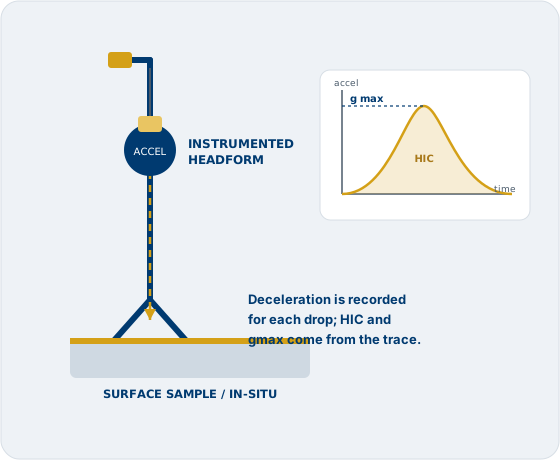
EN 1177 provides two methods. We carry out both — on site and in the laboratory — using an instrumented headform that records the deceleration of each controlled drop.
Determination of critical fall height
The core test. An instrumented headform is dropped onto the surface from increasing heights until the HIC or gmax limit is reached. The result is the surface's certified critical fall height — used for specification, procurement and product certification. Carried out in the laboratory on samples, or on site on the installed surface.
On-site impact attenuation
Introduced in the 2018 edition for confirming, after installation or later in a surface's life, that it still attenuates impact as required for that location. Ideal for handover sign-off and for periodic checks within an inspection regime.
A straightforward four-step process.
- 1. Scope. Tell us the equipment heights, surface type and location. We confirm whether on-site or laboratory testing fits.
- 2. Test. We carry out the drop tests across the impact area, recording HIC and gmax at each point.
- 3. Report. You receive a clear report stating the critical fall height with measurement uncertainty, and a pass/fail against the equipment above.
- 4. Advice. If a surface falls short, we set out the options objectively — we have nothing to sell you in the way of surfacing.