Critical fall height, HIC and gmax — in plain terms.
Critical fall height (CFH)
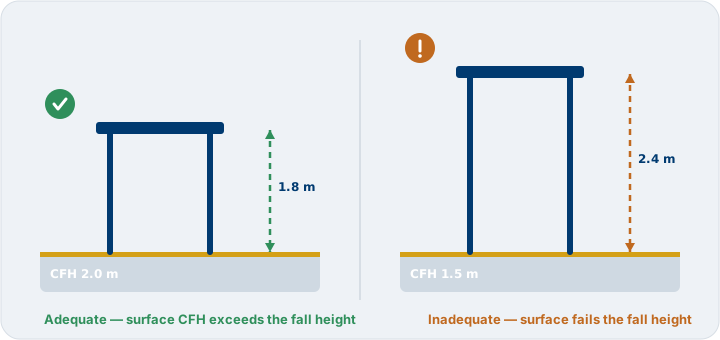
The critical fall height is the maximum free height of fall for which a surface provides an acceptable level of impact protection. It is the single figure that tells you whether a surface is suitable beneath a given piece of equipment: if the highest accessible point of the equipment is 2 m, the surface beneath it needs a critical fall height of at least 2 m.
Head Injury Criterion (HIC)
HIC is a measure of how severe a head impact is, calculated from the deceleration recorded when an instrumented headform is dropped onto the surface. The higher the HIC, the greater the risk of serious head injury. Under EN 1177 the surface must keep HIC at or below 1000.
Peak deceleration (gmax)
Alongside HIC, the 2018 standard sets a ceiling on peak deceleration — the sharpest g-force spike during the impact — of 200 g. A surface has to satisfy both limits to pass at a given height.
How the two combine into a CFH
The headform is dropped from progressively greater heights. The critical fall height is the lowest drop height at which the surface first reaches HIC 1000 or gmax 200 — in other words, the highest fall the surface can safely absorb.
| Measure | What it tells you | Limit |
|---|---|---|
| HIC | Severity of a head impact | ≤ 1000 |
| gmax | Peak deceleration on impact | ≤ 200 g |
| CFH | Maximum fall the surface protects against | Match to equipment height |